Journal
Elon Musk and the First Trillionaire: What Rockefeller's Fortune Shows
What the First Billionaire Reveals About the First Trillionaire
As Elon Musk nears $1 trillion, the story of John D. Rockefeller shows how fortunes of that scale reshape markets, politics and public opinion. By Ben Steverman
We seem to be entering our trillionaire era. As recently as late 2017, no one on Earth had ever been worth more than $100 billion. Less than a decade later, 18 people on the Bloomberg Billionaires Index clear that mark. A successful SpaceX initial public offering could make Elon Musk, whose fortune now tops $670 billion, the world’s first trillionaire. And at this rate, he may not be the last this decade.
If this feels unprecedented, it is. But it’s also reminiscent of another era. At the turn of the 20th century, bewildering social and technological changes, polarized politics and soaring wealth at the very top left Americans feeling anxious and confused. Among the concepts they struggled to grasp was the word “billion” itself. As the first billionaire fortune came into view, a newspaper noted in 1903 that a billion dollars is “as many dollars as there have been minutes since the dawn of Christianity.”
And yet our current challenge is wrapping our head around a thousand of those billions — as many dollars as there have been minutes since the dawn of the Ice Age.
The difference between four commas and three is vast. A billionaire can spend $1,000 every day for roughly 2,700 years, while a trillionaire could spend $1 million a day for just as long. Whether they’re Musk, Mark Zuckerberg or an as-yet-unknown contender from the artificial intelligence boom, what does that much wealth mean in the hands of one person?
John D. Rockefeller offers one answer. As early as 1890, when the 50-year-old’s net worth had barely cracked $100 million, people were predicting he would be the first billionaire. With Standard Oil throwing off cash, his wealth doubled by the end of the 19th century despite a nasty recession, then accelerated in the early 1900s. By 1915, his fortune was well past $1 billion, according to my analysis of available historical data.
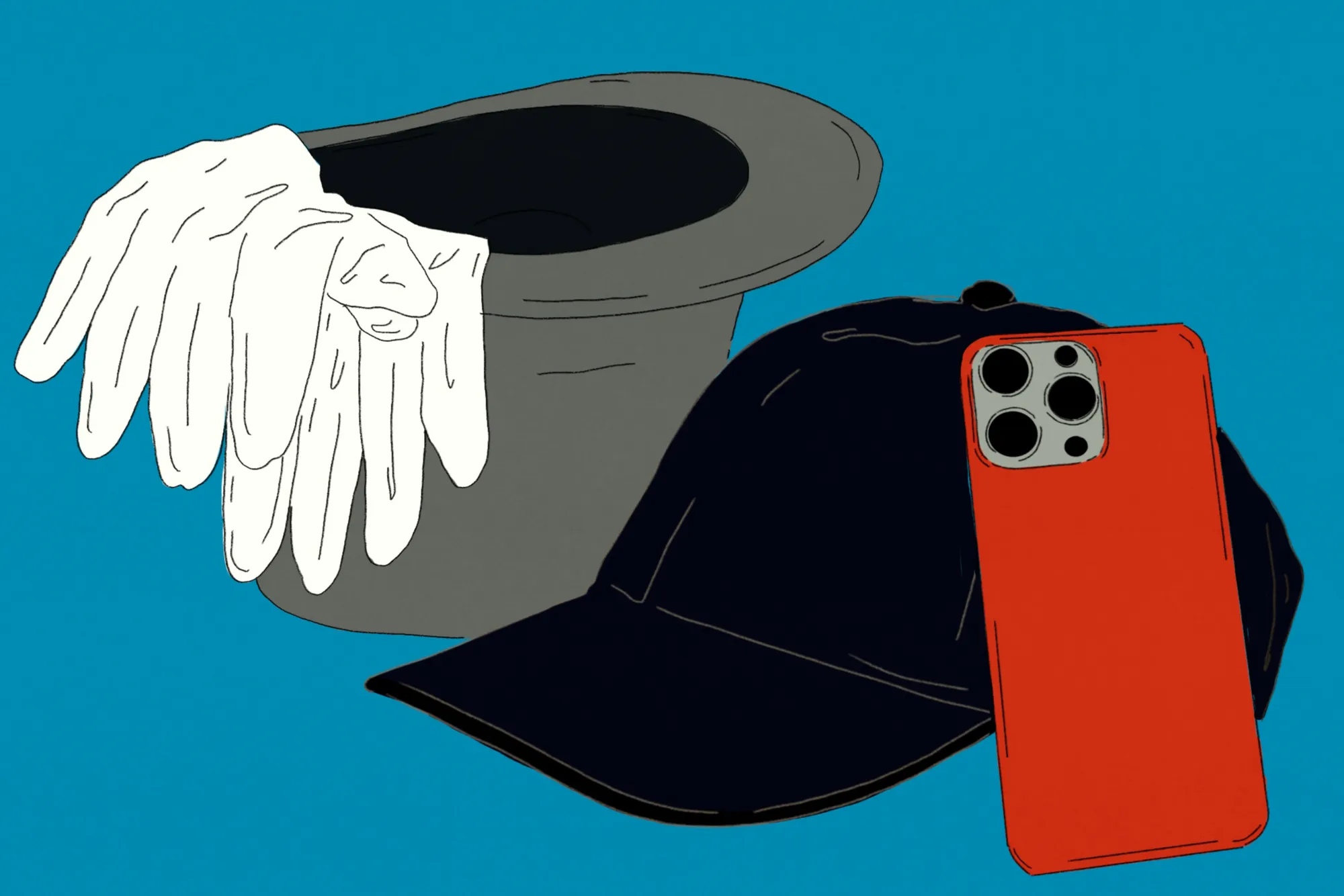
Illustration: Kimberly Elliot for Bloomberg
Adjusted for inflation, Rockefeller’s $1.3 billion in 1915 is about $40 billion today, putting him at a mere 54th on the Bloomberg Billionaires Index. But a better way to gauge the power that his wealth wielded is to compare it with the size of the US economy. By this measure, Rockefeller in 1915 owned the largest private fortune ever assembled — an amount equal to roughly one-thirtieth of US GDP at the time, or just over $1 trillion in today’s dollars.
A person this rich isn’t like other wealthy people. Conspiracy theories aside, billionaires and multimillionaires rarely agree on anything, even tax policy. In politics, business and everything else, they’re often at odds. But as an individual’s wealth soars past a certain point, constraints and countervailing forces fall away. They win a unique ability to reshape the world, though as Rockefeller’s story also demonstrates, they are not all-powerful. Their pervasive influence can spark a backlash from the general public so ferocious that politicians feel they must respond.
我们似乎正步入一个“万亿富翁”的时代。就在2017年末,地球上还没有人的身价超过1000亿美元。然而不到十年后的今天,彭博亿万富翁指数上已有18人跨越了这一大关。如果SpaceX成功上市,身价现已超6700亿美元的埃隆·马斯克有望成为世界首位万亿富翁。照此趋势,在本十年内,他或许不会是唯一的一位。
若这种感觉显得前所未有,那事实的确如此。但这同时也让人联想到另一个时代。在20世纪之交,剧烈的社会与科技变革、政治极化以及顶层财富的激增,曾令美国人深感焦虑与困惑。在当时人们难以理解的概念中,就包括“十亿”这个词本身。随着首位亿万富翁的财富初露端倪,一家报纸在1903年曾如此描述:十亿美元的数量,相当于“自基督教诞生以来经过的每一分钟”。
而我们当下面临的挑战,则是要去理解一千个那样的“十亿” 这几乎相当于自冰河时代开启以来的每一分钟。
在数字的写法上,拥有四个逗号与拥有三个逗号的区别,其差距可谓天壤之别。亿万富翁可以每天花费1000美元,持续约2700年;而万亿富翁即便每天挥霍100万美元,也能维持同样长的时间。无论是马斯克、马克·扎克伯格,还是人工智能浪潮中尚未露面的挑战者,如此巨额的财富集中在一人手中,究竟意味着什么?
约翰·D·洛克菲勒给出了一个答案。早在1890年,当时这位50岁的实业家净资产刚突破1亿美元,人们就预言他将成为首位亿万富翁。凭借标准石油公司源源不断的现金流,尽管经历了严重的经济衰退,他的财富在19世纪末仍翻了一番,并在20世纪初加速增长。根据我对现有历史数据的分析,到1915年,他的财富已远超10亿美元。
The Road to Riches
At the time of Rockefeller’s ascent, people couldn’t understand what anyone would do with $1 billion — a single dollar could buy the nicest dish at the fanciest restaurants in town. Even today, after 110 years of inflation, $1 billion is logistically difficult to spend in one lifetime. Jeff Bezos was criticized for his wedding in Venice, which reportedly cost around $20 million. But at that price, the couple could renew their vows in equally luxurious surroundings every weekend for the next year without hitting $1 billion.
To better understand what it feels like at the center of a vast fortune, I traveled by train along the icy Hudson River to Tarrytown, New York. My destination, the Rockefeller Archive Center, was a couple miles up into the hills from the station, behind a steel gate on what was once the family’s 3,000-acre estate. The Rockefeller archive’s home is Hillcrest, a tidy mansion built for John D. Rockefeller Jr.’s widow in 1963. Three levels of vaults under the house contain the records of the Rockefeller family, the philanthropies they founded and dozens of other organizations.
I chose to start with correspondence between Rockefeller Sr. and his only son. Overshadowed in history, John D. Rockefeller Jr. idolized his father and deferred to him for most of his first 40 years. More and more after 1910, however, it was the younger Rockefeller who ran the family affairs, while his retired septuagenarian father enjoyed a rigorous schedule of golf and automobile rides.
In the first folder I opened, the family’s idiosyncrasies leapt off the page. Rockefeller Sr. built Standard Oil by squeezing every cent from refining and shipping petroleum — an obsession with efficiency his son inherited. In one letter, Junior itemizes his annual expenses ($83,238.35, including a $25,000 donation to Brown University, his alma mater). In another, he declines as unnecessary an offer to upgrade the stables behind his New York City home. In yet another, he thanks his father for “a very substantial saving in our household expense” from the shipment of “$11.10 worth of asparagus.”
The letter reveals the Rockefellers’ trademark frugality alongside their extraordinary privilege. At a time when the average factory worker’s wage was 20 cents an hour, $11.10 of asparagus would have been an unimaginable luxury for almost everyone.
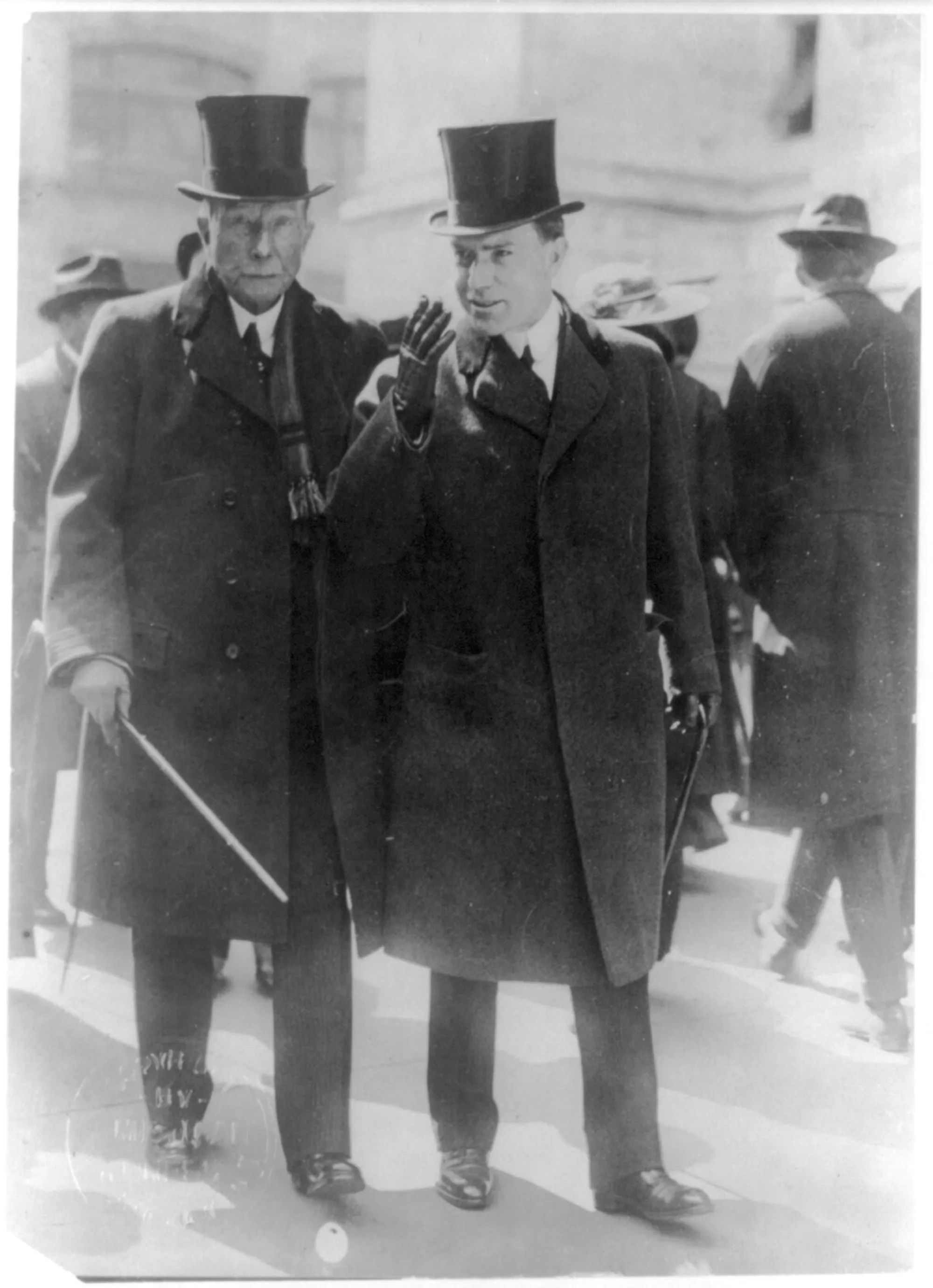
John D. Rockefeller Sr. with his son. Photographer: Alpha Stock/Alamy/www.alamy.com
The bigger difference between then and now may be how Americans reacted to that gulf. The Rockefellers and other industrialists faced fierce backlash — and politicians in both parties acted on it. In 1903, a Democratic congressman from Indiana proposed “to condemn as a public nuisance and a public peril” anyone worth more than $10 million, with the government confiscating the rest. President Theodore Roosevelt launched a legal assault on the “trusts,” including Standard Oil, and urged an estate tax on “those swollen fortunes which it is certainly of no benefit to this country to perpetuate.”
In this heated climate, private letters show neither Rockefeller wanted to be known as a billionaire. In 1916, Senior called press reports that he was worth $1 billion “preposterous.” Junior worried the articles were “having so unfortunate an influence on the public mind,” by supporting the arguments of progressives, communists and anarchists that US laws were “unwise or inadequate.”
The family’s advisers, including their public-relations guru, Ivy Lee, decided against issuing a statement. But two years later, after Forbes magazine placed the Rockefeller net worth at $1.2 billion, letters suggest Lee had a talk with the publisher. In the following issue, B.C. Forbes walked back his estimate, saying he’d since been assured Rockefeller was “nowhere near a billion dollars” after all.
致富之路
在洛克菲勒崛起的时代,人们无法理解有人会如何使用10亿美元。那时,一美元就能在城里最高档的餐厅点上一道最精美的菜肴。即便在今天,在经历了110年的通货膨胀之后,10亿美元也是很难在一生中花完的数字。杰夫·贝索斯因在威尼斯举办婚礼而备受批评,据称这场婚礼耗资约2000万美元。但在这个价位上,即使这对夫妇未来一年每周都在同样奢华的环境下重申誓言,也花不到10亿美元。
为了更好地理解身处巨额财富核心的感觉,我乘火车沿着冰封的哈德逊河前往纽约州塔里敦。我的目的地是洛克菲勒档案中心,从车站向山上走几英里,穿过一扇钢制大门,那里曾经是家族3000英亩庄园的一部分。洛克菲勒档案的所在地是希尔克雷斯特,一座整洁的宅邸,1963年为小约翰·D·洛克菲勒的遗孀建造。房子下方的三层拱形库房存放着洛克菲勒家族、他们建立的慈善基金会以及数十个其他机构的档案。
我选择从老洛克菲勒与独生子之间的通信开始。在历史上被掩盖了光芒的小约翰·D·洛克菲勒十分崇拜父亲,在他生命的前40年里大部分时间都听从父亲的安排。然而,1910年之后,越来越多地是由小洛克菲勒掌管家族事务,而年过七旬、已退休的父亲则享受着高尔夫和汽车出游的紧凑日程。
我打开第一个文件夹,家族的怪癖跃然纸上。老洛克菲勒通过从石油精炼和运输中榨取每一分钱建立了标准石油,这种对效率的执着也被他的儿子继承。在一封信中,小洛克菲勒详细列出了他的年度开支(83,238.35美元,包括向母校布朗大学捐赠的25,000美元)。在另一封信中,他拒绝了升级纽约住宅后方马厩的提议,认为这并无必要。还有一封信里,他感谢父亲运输“价值11.10美元的芦笋”,称这“为我们的家庭开支带来了非常可观的节省”。
这封信揭示了洛克菲勒家族的特点:在拥有非凡特权的同时,保持着标志性的节俭。在这个普通工厂工人工资为每小时20美分的时代,11.10美元的芦笋对几乎所有人来说都是难以想象的奢侈品。
当时与现在更大的差别,或许在于美国人对这种贫富差距的反应。洛克菲勒和其他实业家面临着激烈的反弹,两党政治家都据此采取了行动。1903年,印第安纳州的一位民主党国会议员提议“将任何资产超过1000万美元的人定为公害和公共危险”,由政府没收其余资产。西奥多·罗斯福总统则对包括标准石油在内的“托拉斯”发起法律攻击,并敦促对“对这个国家肯定没有任何益处的那些膨胀财富”征收遗产税。
在这个充满火药味的氛围中,私人信件显示,没有一位洛克菲勒愿意被称为亿万富翁。1916年,老洛克菲勒称关于他身价10亿美元的新闻报道“荒谬至极”。小洛克菲勒担心这些文章“对公众舆论产生了如此不幸的影响”,因为这支持了进步主义者、共产主义者和无政府主义者的论点,即美国法律“并不明智,也不充分”。
家族的顾问,包括他们的公关大师艾维·李,决定不发表声明。但两年后,在《福布斯》杂志将洛克菲勒的净资产定为12亿美元后,信件显示李曾与出版商谈过一次。在下一期杂志中,B.C.福布斯收回了自己的估计,称他后来已获确认,洛克菲勒“根本不到10亿美元”。
Eat the Rich?
For rich Americans like the Rockefellers, the transition from the first Gilded Age to the Progressive Era was harrowing. By the early 1900s, Rockefeller was one of the most hated men in America, after muckraking journalists exposed the cutthroat tactics he had deployed building Standard Oil. Dodging process servers and criminal indictments, he watched as a trust-busting federal lawsuit against his beloved company rose all the way to the Supreme Court. In 1911, the high court ruled unanimously against Standard Oil, ordering the monopoly broken up into dozens of subsidiaries.
In a letter to his father the next year, Junior complained of a “general spirit and feeling of social and political unrest throughout various countries of the world.” He cited a revolution in China, a massive coal strike in England and the 1912 US presidential election, in which candidates including former president Roosevelt were offering competing proposals to soak the rich. “The financial interests of the country would seem to be more seriously threatened than heretofore,” Junior added in his understated way. Indeed, a year later, the Rockefellers faced their first federal income tax bills — at a 7% rate on earnings over $500,000 — after bipartisan majorities in the nation’s capital and more than 40 states ratified a constitutional amendment endorsing the levy.
The threats weren’t just financial. In a couple letters in the archive, Junior sounds almost paranoid, worrying that Italian anarchists might have infiltrated the staff on their New York estate. (His father calmly replies that “we do not want the impression to go out that we are not going to employ any Italians.”) But Junior also had reasons to worry, especially after 1914, when he joined his father as one of the most hated men in America.
That spring, agents of a Rockefeller-owned coal company massacred striking miners and their families in Ludlow, Colorado. Though thousands of miles away at the time, Junior was on the company’s board, and had defended its harsh tactics in what came to be known as the Colorado Coalfield War. As politicians accused the heir of murder, a bomb exploded on the Upper East Side of Manhattan. Three anarchists and a neighbor were killed by the blast, which was intended for the Rockefeller estate 25 miles north. Ten days later, Senior warned his son of rumors that two assassins from Colorado were on their way to find him at the family’s Maine vacation estate.
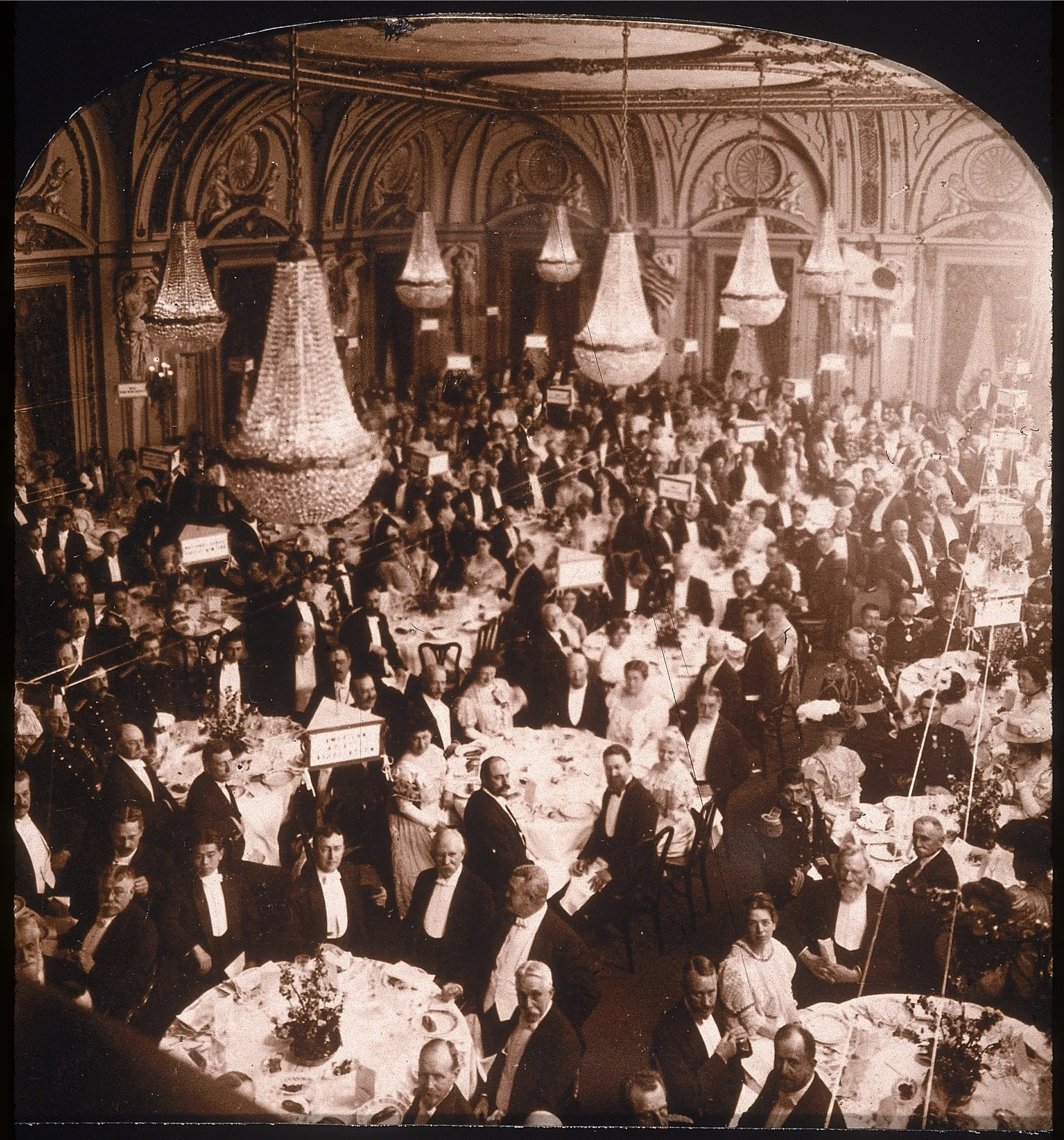
For rich Americans, the shift into the Progressive Era was unsettling. Here, tuxedoed men and women dine at the Astor Hotel on Long Acre Square, now Times Square. Built in 1904, it was among the first US hotels with indoor plumbing and functioned as a quasi-capital for visiting elites. Photographer: Archive Photos/Getty Images
That threat never materialized, but the Rockefellers and other rich Americans were worried. The next month, with Europe heading to war and a tough antitrust bill sailing through Congress, Junior joined a gathering of wealthy folk and two conservative senators on J.P. Morgan Jr.’s yacht. “The prevailing opinion was one of discouragement,” Rockefeller reported to his father. After the US joined the war a few years later, the world’s richest family’s income tax rate would jump to 77%.
Today, the top 1% of Americans control around 32% of US wealth, the Federal Reserve estimates, the highest level since World War II. Yet often in the past few decades, it has seemed as if Americans were unperturbed by the great fortunes in their midst, with at least as many idolizing the wealthy as angry at them. The US estate tax, approved in 1916, is today riddled with loopholes that make it possible to pass on billions of dollars tax-free. Twice US voters have elected Donald Trump, a billionaire whose crypto and social media ventures have helped more than double his fortune since he left office in 2021. Last year Trump temporarily allowed Musk to turn the federal workforce upside down by way of the Department of Government Efficiency, or DOGE. In a November 2025 Harris Poll, a narrow majority of Americans, 53%, said they “look up to billionaires.”
吃掉富人?
对于像洛克菲勒家族这样的美国富人来说,从第一镀金时代过渡到进步主义时代的过程是惊心动魄的。到20世纪初,洛克菲勒成为美国最遭人憎恨的人之一,因为扒粪记者揭穿了他建立标准石油的过程中所使用的残酷手段。躲避着传票送达员和刑事指控的同时,他眼睁睁地看着针对他心爱公司的联邦反垄断诉讼一路上诉到了最高法院。1911年,最高法院一致判决标准石油败诉,命令将其拆分为数十家子公司。
第二年,小洛克菲勒在给父亲的信中抱怨道:“世界各地都弥漫着一种社会和政治动荡的精神与情绪。”他提到了中国的革命、英国的大规模煤矿罢工以及1912年的美国总统大选。在这次选举中,包括前总统罗斯福在内的多位候选人都提出了向富人开刀的竞争性提案。“这个国家的金融利益似乎比以往任何时候都面临更严重的威胁。”小洛克菲勒以他一贯轻描淡写的方式补充道。确实,一年后,洛克菲勒家族收到了第一笔联邦所得税账单,对超过50万美元的收入征收7%的税率;在此之前,美国首都和40多个州的两党多数已批准一项宪法修正案,为此项税收背书。
威胁不仅是财务上的。在档案中的几封信里,小洛克菲勒听起来几乎有些偏执,担心意大利无政府主义者可能已经渗透了他们纽约庄园的工作人员。(他的父亲平静地回复说:“我们不想给人留下我们不再雇佣任何意大利人的印象。”)但小洛克菲勒确实有理由担心,特别是在1914年之后,当时他和父亲一道成为美国最遭人憎恨的人。
那一年的春天,一家洛克菲勒拥有的煤矿公司代理人在科罗拉多州勒德洛屠杀了罢工矿工及其家人。虽然当时身在数千英里之外,但小洛克菲勒担任着该公司董事会的职务,并曾为其在后来被称为科罗拉多煤矿战争中的严厉手段进行辩护。当政治家们指控这位继承人犯有谋杀罪时,曼哈顿上东区发生了一起爆炸事件。三名无政府主义者和一名邻居在爆炸中丧生,而爆炸的目标是25英里以北的洛克菲勒庄园。十天后,老洛克菲勒警告儿子说,有传言称两名来自科罗拉多的刺客正在前往他们在缅因州度假庄园寻找他的路上。
那个威胁从未成为现实,但洛克菲勒家族和其他美国富人确实忧心忡忡。下个月,随着欧洲走向战争,一项强硬的反垄断议案在国会顺利通过,小洛克菲勒在小J.P.摩根的游艇上参加了一次富人聚会,两位保守派参议员也在场。“普遍情绪是沮丧的。”洛克菲勒向父亲报告说。美国在几年后加入战争后,这个世界上最富有家庭的所得税税率将跃升至77%。
美联储估计,如今美国最富有的1%的人控制着美国约32%的财富,这是二战以来的最高水平。然而,在过去的几十年里,美国人似乎对身边的巨额财富并不十分介意,至少崇拜富人的人数并不比憎恶他们的人少。1916年批准的美国遗产税如今漏洞百出,使免税传承数十亿美元成为可能。美国选民两次将唐纳德·特朗普送入白宫,这位亿万富翁的加密货币和社交媒体业务帮助他自2021年卸任以来将财富翻了一倍多。去年,特朗普还曾允许马斯克通过政府效率部(DOGE)暂时搅动联邦官僚体系。在2025年11月的一项哈里斯民调中,略占多数的美国人,53%,表示他们“仰慕亿万富翁”。
The Fall and Rise of American Inequality
Line interpolates through early years where published annual estimates are sparse.
Source: World Inequality Database; adults, equal split of net personal wealth
But recently there are signs of a shift. The share of Americans who say they admire billionaires fell 8 percentage points in the Harris Poll from mid-2024. Two-thirds now agree that “billionaires are creating more of an unfair society,” including 57% of Republicans, and nearly three-quarters say they aren’t doing enough with their fortunes to better society. Public opinion of Musk and Trump has also soured: 58% view each of them unfavorably, according to a recent Pew Research Center survey of 8,500 Americans.
While the wealthy pay some of the lowest federal income tax rates in a century, several states are threatening to hike levies on their richest residents. The most prominent is California, where progressives including Vermont Senator Bernie Sanders and University of California at Berkeley economist Emmanuel Saez are championing a ballot measure to impose a one-time 5% wealth tax on billionaires. Approval of the levy “could well mark a turning point,” Saez said, or, if it loses, “signal that the second Gilded Age has not yet run its course.”
但近来,情况出现了转变的迹象。哈里斯民调(Harris Poll)显示,自2024年中期以来,表示钦佩亿万富翁的美国人比例下降了8个百分点。目前有三分之二的人认为“亿万富翁正在加剧社会的不公平”,其中包括57%的共和党人;此外,近四分之三的人认为,这些富豪并未利用其财富充分回馈社会。公众对马斯克和特朗普的态度也趋于恶化:根据皮尤研究中心(Pew Research Center)最近对8500名美国人的调查,58%的受访者对这两位持负面看法。
尽管目前富豪阶层缴纳的联邦所得税税率处于近一个世纪以来的最低水平,但已有数个州威胁要提高对最富有居民的税收。其中最引人注目的是加利福尼亚州,包括佛蒙特州参议员伯尼·桑德斯(Bernie Sanders)和加州大学伯克利分校经济学家伊曼纽尔·赛斯(Emmanuel Saez)在内的进步人士,正积极推动一项投票提案,拟对亿万富翁征收5%的一次性财富税。赛斯表示,这项税收的通过“很可能标志着一个转折点”;反之,如果提案失败,则“预示着‘第二个镀金时代’尚未走向终结”。
How to Leverage a Fortune
Then and now, the path to billionaire or trillionaire can be conceptually simple if practically rare. Start a company, grow it into a globe-spanning behemoth and hang onto a significant ownership stake. Jensen Huang’s 3.3% slice of Nvidia Corp. is enough to make him one of the 10 richest people in the world. So is Larry Ellison’s 40%-plus stake in Oracle Corp., though his software company trades at a fraction of Nvidia’s $4.5 trillion market capitalization. Rockefeller owned about a quarter of Standard Oil shares. If Huang held that much of Nvidia, we’d have a trillionaire by now.
The first billionaire and the leading contender for first trillionaire each put their own twists on this route to riches. Musk has spread his bets across multiple companies — sometimes combining them — and keeps investors interested by frequently shuffling up their business strategies. Tesla is moving into taxis and robots, he says, while satellite company SpaceX recently merged with his social network, X, and his artificial intelligence firm, xAI.
But modern mega-fortunes are volatile. Musk so dominates the headlines and wealth rankings that it’s easy to forget he first climbed to the top of the Bloomberg Billionaires Index five years ago, and that his current reign as world’s richest person started only in June 2024. When the index debuted in 2012, Carlos Slim was the world’s richest person. Then it was Bill Gates, who still holds the overall record for tenure at the top. Bezos and Bernard Arnault have swapped the top spot with Musk several times in the past few years, and as recently as September, a surge in Oracle stock put Ellison at the top for most of a day before the market closed with Musk ahead.
无论是过去还是现在,成为亿万或万亿富翁的路径在概念上虽简单,但在实践中却极度罕见:创办一家公司,将其发展成为横跨全球的庞然大物,并持有大量所有权股份。黄仁勋持有的英伟达(Nvidia Corp.)3.3%的股份,就足以让他跻身全球十大富豪之列。拉里·埃里森在甲骨文(Oracle Corp.)持有的40%以上股份亦是如此,尽管他的软件公司市值仅为英伟达4.5万亿美元市值的一小部分。洛克菲勒曾持有标准石油公司约四分之一的股份,如果黄仁勋也持有同等比例的英伟达股份,我们现在已经见证了一位“万亿富翁”的诞生。
史上首位亿万富翁(洛克菲勒)和首位万亿富翁的头号竞争者(马斯克),在这一致富路径上各出奇招。马斯克采取了多线布局的策略——有时还会将业务进行整合——并通过频繁调整经营战略来维持投资者的兴趣。他表示,特斯拉正在向出租车和机器人领域进军,而其卫星公司SpaceX近期也与其社交网络X以及人工智能公司xAI进行了业务整合。
然而,现代巨额财富具有极强的波动性。马斯克在新闻头条和财富榜单中的统治地位,常让人忘记他是在五年前才首次登上彭博亿万富翁指数(Bloomberg Billionaires Index)榜首的,而他目前作为世界首富的“统治期”也仅始于2024年6月。该指数于2012年首次发布时,卡洛斯·斯利姆是世界首富。随后是比尔·盖茨,他至今仍保持着蝉联榜首时间最长的总纪录。在过去几年中,贝佐斯和贝尔纳·阿尔诺曾多次与马斯克轮番坐庄;就在不久前的9月,甲骨文股价的飙升曾让埃里森在一天的大部分时间里位居榜首,直到收盘时马斯克才重新实现反超。
The Race to $1 Trillion
- Elon Musk
- Larry Page
- Jeff Bezos
- Larry Ellison
- Mark Zuckerberg
- Jensen Huang
Source: Bloomberg Billionaires Index
The Rockefeller fortune rested on sturdier foundations. From 1883 to 1906, Standard Oil paid $550 million in dividends, allowing Rockefeller to diversify into railroads, mines, steel and banks. By 1911, Rockefeller’s stake in Standard Oil was likely less than a quarter of his total holdings.
Even so, after the Supreme Court loss and amid other looming threats, it looked like Rockefeller Sr. might never become a billionaire. Then Europe went to war and the gasoline automobile took off, driving demand for petroleum. Though split into dozens of subsidiaries, Standard Oil’s successors surged in value and paid hefty dividends. After a brief crisis in 1914, the broader market rebounded as well. Financial journalists now assured readers that Rockefeller was worth at least $1 billion, if not $2 billion.
It may be true that Rockefeller was no longer a billionaire in 1918, when Lee persuaded Forbes to revise his estimate. Approaching 80, with an estate tax looming, Senior began transferring large portions of his fortune to his son. But I’m confident he had crossed the billion mark earlier. A family estimate cited in Allan Nevins’ sympathetic 1953 biography pegged their wealth around 1912 — with typical Rockefeller precision — at $815,647,796.89. Nevins argued that figure proved “Rockefeller was never quite a billionaire,” but the math suggests otherwise. According to historical data from Finaeon Inc., shares of Standard Oil and its successors tripled from 1912 to 1916, while the broader market surged as well. His fortune could easily have reached $1.5 billion.
洛克菲勒的财富建立在更为稳固的基础之上。从1883年到1906年,标准石油公司(Standard Oil)支付了5.5亿美元的股息,这使得洛克菲勒能够将投资多元化,扩展到铁路、矿山、钢铁和银行等领域。到1911年,他在标准石油的股份可能还不到其总资产的四分之一。
即便如此,在最高法院判决败诉以及其他威胁接踵而至的情况下,老洛克菲勒似乎永远无法跨入“亿万富翁”的行列了。然而,随后欧洲爆发了战争(一战),汽油动力汽车开始普及,极大地推动了石油需求。尽管被拆分成了数十家子公司,但标准石油的继任公司市值大幅飙升,并支付了巨额股息。在经历1914年的短暂危机后,大盘也随之反弹。此时,财经记者们向读者确信地表示,洛克菲勒的身家即便没有20亿,也至少有10亿美元。
1918年,当李(Ivy Lee,洛克菲勒的公关顾问)说服福布斯(B.C. Forbes)修正其估值时,洛克菲勒可能确实不再是亿万富翁了。当时他已年近八旬,加之遗产税迫在眉睫,老洛克菲勒开始将大部分财产转移给儿子。但我确信,他在此之前就已经突破了10亿美元的大关。阿兰·内文斯(Allan Nevins)在他那部带有同情色彩的1953年传记中,引用了一份家族估算,将他们1912年左右的财富定格在——带着典型洛克菲勒式的精确——815,647,796.89美元。内文斯认为,这一数字证明了“洛克菲勒从未真正成为亿万富翁”,但数据计算却给出了不同的结论。根据Finaeon公司的历史数据,标准石油及其继任公司的股价在1912年至1916年间翻了两番(增至三倍),同时大盘也在飙升。他的财富在那时完全可能轻易达到15亿美元。
Rockefeller’s Climb to $1 Billion
Estimated year-end net worth of John D. Rockefeller, Sr.
Dots mark years with explicit historical estimates; intervening years are smoothed between them.
Source: Bloomberg analysis based on historical records, including donation tallies and stock performance; Standard Oil data provided by Finaeon, Inc.
Were the Rockefellers lying? Not necessarily. Tallying up his own fortune, Senior may have thought of his wealth in more tangible terms — in pipelines, refineries and the regular dividends these capital investments paid back — rather than in market valuations. As quickly as so-called paper wealth can be created, it can be destroyed by a swing of the market’s mood. The same might be said of the first trillionaire, especially if it’s Musk, who has persuaded investors to value his businesses many times more than other companies with comparable revenues and profits.
But a billion is still a billion, and a trillion is still a trillion. Even if they never sell out of the companies they found, the super-rich today can borrow against their giant stakes to raise cash. It’s a technique Ellison has been using to help his son, David, try to take over much of Hollywood.
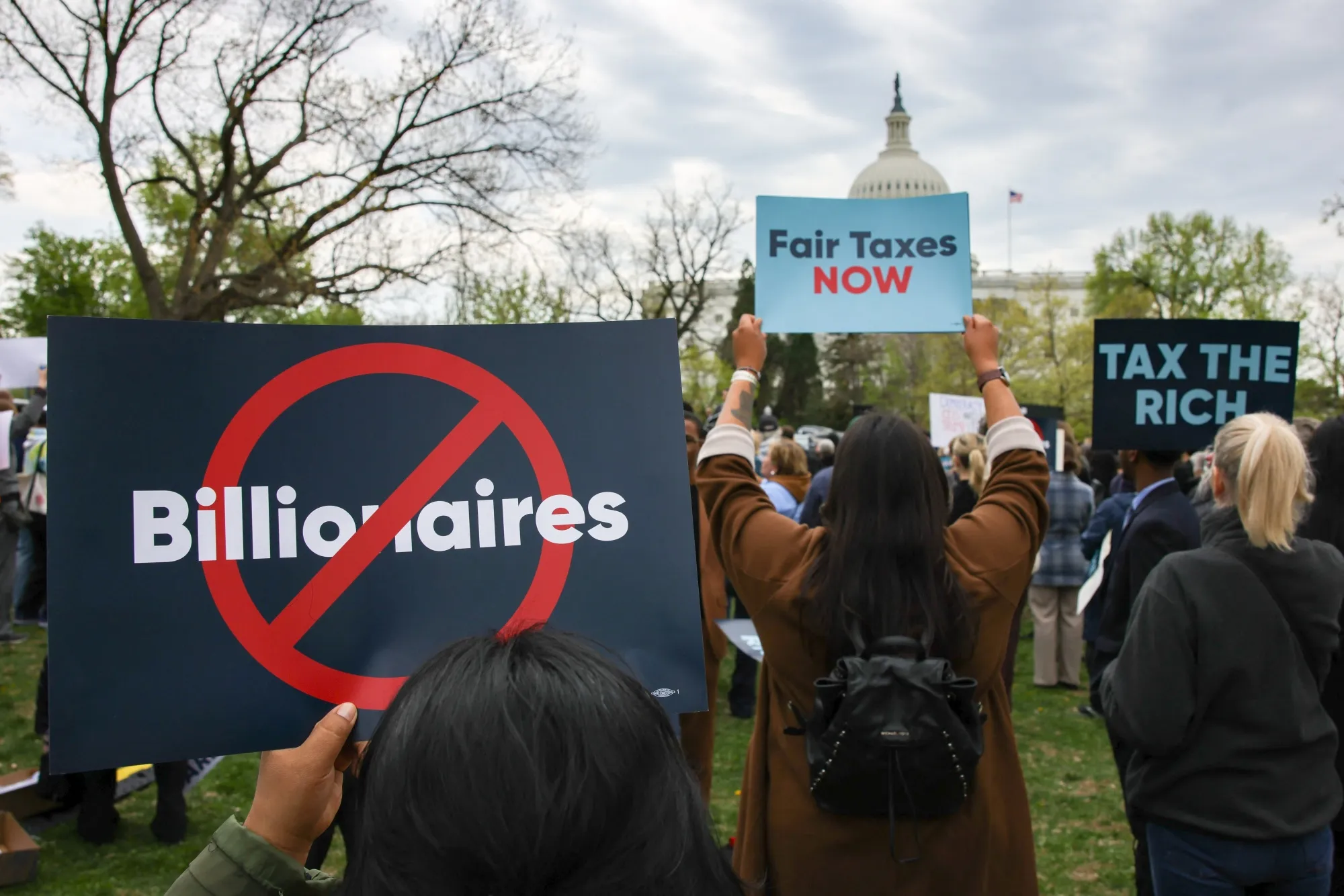
Protesters attend a rally in support of fair taxation in Washington, DC, on April 10, 2025. America’s wealthy currently pay some of the lowest federal income tax rates in a century. Photographer: Bryan Dozier/AFP/Getty Images
The Rockefellers leveraged their fortune in other ways. Saying he wanted his money used “for the benefit of mankind,” Senior gave $540 million to charity in his lifetime, mostly to the Rockefeller Foundation and other grantmaking organizations under his son’s control. Another $500 million went to his family, almost all to Junior, who went on to donate $537 million himself, according to John Ensor Harr and Peter J. Johnson’s 1988 biography. These are astonishing sums for the early 20th century, when just $10,000 was often enough to launch a major research or reform initiative.
By the time Rockefeller Sr. died in 1937 at the age of 97, one of the most hated men in American history was among the most admired, almost as much as his full-time philanthropist son. But the Rockefellers’ $1 billion bought more than just popularity. True to form, they seemed to squeeze every cent of value from their donations, particularly after Junior took charge in the 1910s.
Lists of small Rockefeller donations fill thousands of pages in the archives, while major beneficiaries include the University of Chicago, Spelman College, Rockefeller University, the Acadia and Grand Teton national parks, the Museum of Modern Art and the Met Cloisters museum in uptown Manhattan. Rockefeller grants transformed the social sciences, the study of public health and especially medical research, eradicating diseases and funding several medical schools, including the Peking Union Medical College. The builder of the (for-profit) Rockefeller Center, Junior particularly loved ambitious construction projects, such as the restorations of Colonial Williamsburg, the Palace of Versailles and the cathedral at Reims. Junior also ensured the United Nations would be headquartered in New York by donating the tract of land along the East River where it sits.
Today’s super-wealthy can also change the world with their philanthropy. But most of the contenders for trillionaire wouldn’t need to give away a cent to affect our lives. The digital worlds where we spend more and more of our time are under their direct control. We argue and entertain ourselves on their social media platforms, and their rush toward AI has the potential to change the course of everything from our careers to the climate.
We usually notice when the super-wealthy rearrange the economy. Harder to spot, because it can take decades to accomplish, is the way their priorities can suffuse society, changing the ways we think and live. Rockefeller Sr. and Jr. were teetotaling Baptists, and the top donors to the Anti-Saloon League, the aggressive lobbying operation that at the tail end of the 1910s persuaded US lawmakers to prohibit the manufacture and sale of “intoxicating liquors” via the 18th amendment to the Constitution. A dozen years later, Junior shocked Americans by publicly admitting Prohibition was a mistake, speeding up its repeal in 1933. Then as liquor became legal again, he quietly provided crucial early financial support to the founders of the movement that would become Alcoholics Anonymous.
There are no term limits on this sort of influence. The more patient, conscientious and creative the super-wealthy are, the more effective they can be. If we’re going to have a trillionaire, it very much matters who that person is and what they do with such seemingly limitless wealth.
洛克菲勒家族在撒谎吗?未必。在清点家产时,老洛克菲勒或许是以更实物化的视角来看待财富的——他看重的是管道、炼油厂以及这些资本投资带来的定期股息,而非变幻莫测的市场估值。所谓的“账面财富”创造起来有多快,在市场情绪的波动中灰飞烟灭就有多快。对于未来的首位万亿富翁,这种说法或许同样适用,特别是如果此人是马斯克的话——他成功地说服了投资者,让其公司的估值达到了营收和利润规模相当的其他公司的数倍。
但十亿终究是十亿,万亿也终究是万亿。即使当今的超级富豪从未抛售过自己创办公司的股份,他们也可以利用这些巨额持股作为抵押来筹集现金。埃里森就一直在利用这种手段帮助他的儿子大卫(David)尝试接管好莱坞的大部分版图。
洛克菲勒家族则以其他方式发挥了财富的杠杆作用。老洛克菲勒曾表示希望其财富能“造福人类”,他在一生中捐出了5.4亿美元用于慈善,其中大部分捐给了洛克菲勒基金会以及其他由其子控制的资助机构。另有5亿美元传给了家人,其中几乎全部给了小洛克菲勒。根据约翰·恩索·哈尔(John Ensor Harr)和彼得·J·约翰逊(Peter J. Johnson)1988年出版的传记,小洛克菲勒本人随后也捐出了5.37亿美元。在20世纪初,这些都是惊人的天文数字;当时仅需1万美元往往就足以启动一项重大的研究或改革计划。
到1937年老洛克菲勒以97岁高龄去世时,这位曾经在美国历史上最招人恨的人之一,已经成了最受人钦佩的人物之一,其受爱戴程度几乎与其全身心投入慈善事业的儿子齐名。但洛克菲勒家族的10亿美元买到的不仅仅是名望。秉承一贯的精明作风,他们似乎能让捐出去的每一分钱都发挥出最大的价值,尤其是在20世纪10年代小洛克菲勒接掌大权之后。
在档案馆中,记录洛克菲勒家族小额捐赠的名录足有数千页之多,而主要受益机构则包括芝加哥大学、斯佩尔曼学院、洛克菲勒大学、阿卡迪亚和大提顿国家公园、现代艺术博物馆(MoMA)以及位于曼哈顿上城的修道院博物馆(The Met Cloisters)。洛克菲勒的资助改变了社会科学、公共卫生研究,尤其是医学研究领域——他们消灭了多种疾病,并资助了包括北京协和医学院在内的数所医学院。作为(营利性)洛克菲勒中心的建造者,小洛克菲勒尤其钟情于宏大的建筑工程,例如对殖民地威廉斯堡、凡尔赛宫以及兰斯大教堂的修复。此外,小洛克菲勒还通过捐赠东河沿岸的一片土地,确保了联合国总部最终落户纽约。
当今的超级富豪同样可以通过慈善改变世界。但对于大多数角逐“万亿富翁”头衔的竞争者来说,即使不捐出一分钱,他们也能影响我们的生活。我们投入越来越多时间的数字世界正处于他们的直接控制之下。我们在他们的社交媒体平台上争论或娱乐,而他们对人工智能(AI)的狂热追求,更有可能改变从我们的职业生涯到全球气候的一切走向。
当超级富豪重塑经济格局时,我们通常会有所察觉。但有一种影响更难被察觉,因为其往往需要数十年才能完成——那就是他们的价值观如何渗透并潜移默化地影响整个社会,进而改变我们的思维和生活方式。老洛克菲勒和小洛克菲勒都是滴酒不沾的浸礼会教徒,也是“反沙龙联盟”(Anti-Saloon League)的顶级捐赠者。正是这个激进的游说团体在1910年代末说服了美国立法者,通过宪法第18修正案禁止制造和销售“烈酒”。12年后,小洛克菲勒公开承认“禁酒令”是一个错误,这一表态震惊了美国人,也加速了该法令在1933年的废除。随后,随着酒类合法化,他开始悄悄地为后来成为“匿名戒酒会”(AA)的创始人提供关键的早期资金支持。
这种影响力的发挥并没有“任期限制”。超级富豪越是耐心、越是勤勉、越具创造力,他们的影响力就越深远。如果我们注定要迎来一位万亿富翁,那么此人是谁,以及他将如何运用这笔看似无穷无尽的财富,将变得至关重要。